

Thursday, November 10, 2022

Humility is Truth - Father Walter J Ciszek S.J.
Humility is Truth
“ God must
sometimes allow us to act on our own so we can learn humility, so we can learn
the truth of our total dependence on him, so we can learn that all our actions
are sustained by his grace and that without him we can do nothing—not even make
our own mistakes.
Learning the full
truth of our dependence upon God and our relation to his will is what the
virtue of humility is all about. For humility is truth, the full truth, the
truth that encompasses our relation to God the Creator and through him to the
world he has created and to our fellowmen. And what we call humiliations are
the trials by which our more complete grasp of this truth is tested.
It is self that is humiliated;
there would be no "humiliation" if we had learned to put self in its
place, to see ourselves in proper perspective before God and other men. And the
stronger the ingredient of self develops in our lives, the more severe must our
humiliations be in order to purify us. That was the terrible insight that
dawned upon me in the cell at Lubianka as I prayed, shaken and dejected, after
my experience with the interrogator
The Spirit had not
abandoned me, for the whole experience had been his work. The sense of guilt
and shame I felt was rooted in my failure to put grace ahead of nature, my
failure to trust primarily in God rather than in my own powers..."
From Walter J. Ciszek's book, He Leadeth me
Wednesday, November 9, 2022
On Assisted Suicide and Perspective: A Practical Response - Stephanie Gray - February 11, 2015
I just found this on my computer by Stephanie Gray
On Assisted Suicide and Perspective: A Practical Response
by Stephanie Gray (www.stephaniegray.info)
Last Friday as I flew to Texas to
speak at a mother-daughter event, I stared out the airplane window at the
majesty of the setting sun which had painted the sky red, yellow, orange, and
blue in a breathtaking scene of beauty, and my mind wandered to a stark
contrast: the turmoil going on back in my own country. February 6 was a
dark day for Canada, for it was the day our Supreme Court
overturned the law prohibiting assisted suicide.
In between flights that day, I
saw my newsfeed and e-mail filled with messages of deep sadness, fear, and
dread. These were, and are, healthy reactions to a horrifying decision
that attacks the dignity of the person.
Now that the news has settled
over the weekend, it is good to take a moment to reflect on the importance
of perspective. Holocaust survivor Viktor Frankl, in his book Man’s
Search for Meaning, reminds us of a truth we must cling to during these dark
days: “Everything can be taken from a man but one thing: the last of
the human freedoms—to choose one’s attitude in any given set of circumstances.”
The bad news is that the sick and
vulnerable are in danger in Canada. The good news is that we are in
control of our response to this horrible set of circumstances. No judge
or government or individual can take away how we respond. So a question
each one of us must ask is this: Are the sick and vulnerable, in my circle
of influence, in danger? Each of us determines the answer to that
question.
Consider Lord of the Rings, a
story revolving around a young hobbit, Frodo, who inherits the Ring of Power
and who is charged with the grave responsibility of transporting it to a
volcano to destroy it. At one point, Frodo laments, “I wish the ring
had never come to me. I wish none of this had happened.” And the
wizard Gandalf, replies, “So do all who live to see such times. But that
is not for them to decide. All we have to decide is what to do with the
time that is given to us.”
That is perspective. And
that is what we must continue to come back to in light of the Supreme Court’s
decision. While it is understandable that we lament, “I wish the court
had never decided this. I wish euthanasia didn’t happen in Canada,” we should
focus more on how we have the power to decide what to do with the time that is
given to us, how we can choose our attitude in this present circumstance.
So what are we going to do with
the time that is given to us?
I heartily recommend supporting
worthy causes like The Euthanasia Prevention Coalition. Then, when it
comes to a practical level, I think our primary response to Friday’s decision
should be to love more deeply, and influence more positively, the people around
us. If no one asks for assisted suicide, and if strong people protect
weak people from medical personnel who would be tempted to kill the vulnerable,
assisted suicide and euthanasia won’t happen. So what does that
mean? Each of us, in our particular circle of influence, should seek out
those around us who we can 1) be a friend to and 2) be an advocate for.
Many years ago, pro-life
speaker Camille Pauley spoke about how she visited an elderly,
unresponsive man in a hospital. She spent time visiting him not for
herself, but for him. It didn’t matter that he couldn’t hold a
conversation with her, because what mattered was that she communicated, by her
time and presence and love, that he was valuable, that he was unrepeatable and
irreplaceable, and that he had dignity by his very existence, not by anything
he could do. By simply “Being With” (the name of the program she
developed for this very outreach), she affirmed his worth. If someone is
not made to feel like they are a burden, but instead made to feel that they are
worthy of our time, they are unlikely to ask for assisted suicide.
Practically speaking, I think we
all could do an inventory of our family and friends and think about one or two
in our circle who most need special attention, and then be intentional about
spending more time with them. We could also seek out one or two people we
don’t yet know that we will make time for. I recently sent this message
to my pastor and encourage others to copy and paste the same:
In light of the Supreme Court's
decision to overturn Canada's prohibition on assisted suicide, I believe one of
the best ways we can respond to this horrible ruling is for everyone to make
sure that the people in their circles of influence don't ever ask for assisted
suicide--to make sure that everyone in our circles of influence feels loved and
supported and cared for.
So in asking, “What can I do?” it
occurred to me that there could be someone at our church who is an elderly or
disabled person who is shut in with no family or friends who could use some
visits and help. So I was wondering if you know of a parishioner like
this who could be blessed by someone forming a friendship to spend time with
them? If so, could you please connect me to them?
Alternatively, signing up to
visit at a local elderly home is another practical way to be present and loving
to the vulnerable.
Besides being a friend, we also
need to be an advocate. The dictionary defines this as “a person who speaks or
writes in support or defense of a person.” If one of your family or
friends is hospitalized, are you equipped to ask the right questions and seek
out the right information to ensure their medical treatment is handled in an
ethical fashion? Several years ago I took a certification course in healthcare
ethics through the National Catholic Bioethics Center (NCBC) in Philadelphia. Thanks
to NCBC’s resources, when my friend with a brain tumor was facing possible
end-of-life issues, I was able to share their advice for ethical
decision-making with his wife.
Whether you know how to ethically
handle end-of-life care (e.g., how does one determine whether an intervention
is proportionate versus disproportionate?), or whether you know where to
look for what is the right course of action, another important point for
consideration is this: do you have the legal power to ensure the right thing is
done for your loved ones? Last night I confirmed that I have Power of
Attorney for my parents should they ever be incapable of making medical
decisions on their behalf. This was a legal document I signed several
years ago and you can bet, should it ever need to be enforced, that I will make
decisions on their behalf that respect their dignity. You can bet I will
ensure doctors respond by alleviating suffering, not eliminating the sufferer.
If you are a health care
professional, you can advocate for your patients by practicing ethically and
not allowing the Supreme Court’s decision to cause you to do anything different
except that it motivates you to be more loving, attentive, and compassionate,
someone who exemplifies what it means to be a part of a healing profession.
When we are tempted to be
overwhelmed by the gravity and far-reaching consequences of the Supreme Court’s
decision, let us remember that we are in control of our response. Rather
than despairing or being overwhelmed, let us remember the words of Bishop
Untener of Michigan who said, “We cannot do everything, and there is a sense of
liberation in realizing that. This enables us to do something, and to do
it very well.”
The peace of abandonment to God's will - on a prison train to the labor camps
“….I thought again of that text: "The children of this world are wiser than the children of light." It seemed a peculiar thing to keep running through my mind, and yet a strange and exciting challenge for a priest-apostle on a prison train heading for the labor camps. The challenge seemed plain. Could my sacrifice, could my total dedication, could my stamina in doing the will of God be less than that of the children of this world? They knew that in order to survive a long sentence a man had to face and conquer one day at a time. Had I not resolved to see each day, one day at a time, as a gift of God within whose confines I was to accomplish his will? The prisoners survived by taking life as it came, rolling with the punches, hoping only to survive each day as it happened, one day at a time. Surely my motivation ought to help me see beyond that. Each day to me should be more than an obstacle to be gotten over, a span of time to be endured, a sequence of hours to be survived. For me, each day came forth from the hand of God newly created and alive with opportunities to do his will. For me, each day was a series of moments and incidents to be offered back to God, to be consecrated and returned in total dedication to his will. That was what my priesthood demanded of me, as it demanded of every Christian.
The children of this world were dedicated to surviving this life by whatever method possible. I, too, must be totally dedicated, but with an added dimension. I must not seek to avoid hardships or to soften their impact. I must see in them the will of God and through them work out my salvation. Otherwise, I would be acting rather as a child of this world than a child of light. I would be acting not out of faith but as a fatalist. I would have survived a series of moments, a succession of days, but I would have made nothing of them nor of myself. I resolved again, therefore, to accept each day and every moment as from God's hands, and to offer it back to him as best I could. I would not merely passively survive, like the children of this world, but with his help and his grace I would actively participate—and I would survive. I never doubted that, because I did not fear non-survival. Death would simply be a call to return to the God I served each day. My life was to do the will of God, as the prayer our Savior taught us to put it quite simply, "On earth as in heaven." His will would determine how long I would spend on earth.
In such thoughts and prayers, peace returned. It was the peace, once again, that total abandonment to God's will brings. Only this time I was not in the quiet confines of a solitary cell in Lubianka, I was in the corner of a rough, jolting, profane prison car. My situation had not improved, but my disposition in the acceptance of God's will had returned. Along with it had come peace and a renewed confidence—not in my own ability to survive, but total trust and confidence in God's ability to sustain me and provide me with whatever strength I needed to meet the challenges he would send me. What greater peace and confidence could I require? I even looked forward to laboring again in his vineyard..."
From Walter J. Ciszek's book He Leadeth me
The children of this world were dedicated to surviving this life by whatever method possible. I, too, must be totally dedicated, but with an added dimension. I must not seek to avoid hardships or to soften their impact. I must see in them the will of God and through them work out my salvation. Otherwise, I would be acting rather as a child of this world than a child of light. I would be acting not out of faith but as a fatalist. I would have survived a series of moments, a succession of days, but I would have made nothing of them nor of myself. I resolved again, therefore, to accept each day and every moment as from God's hands, and to offer it back to him as best I could. I would not merely passively survive, like the children of this world, but with his help and his grace I would actively participate—and I would survive. I never doubted that, because I did not fear non-survival. Death would simply be a call to return to the God I served each day. My life was to do the will of God, as the prayer our Savior taught us to put it quite simply, "On earth as in heaven." His will would determine how long I would spend on earth.
In such thoughts and prayers, peace returned. It was the peace, once again, that total abandonment to God's will brings. Only this time I was not in the quiet confines of a solitary cell in Lubianka, I was in the corner of a rough, jolting, profane prison car. My situation had not improved, but my disposition in the acceptance of God's will had returned. Along with it had come peace and a renewed confidence—not in my own ability to survive, but total trust and confidence in God's ability to sustain me and provide me with whatever strength I needed to meet the challenges he would send me. What greater peace and confidence could I require? I even looked forward to laboring again in his vineyard..."
From Walter J. Ciszek's book He Leadeth me
Prayer for the Canonization of Fr. Walter Ciszek
We adore You, Most Holy Trinity, and we thank You
for the exemplary life of Your Servant, Father Walter Ciszek.
We pray that his strong faith in Your loving providence,
his great love for You, and his kindness to all people
be recognized by the Church.
If it be Your Will, may he be given to us
as a saintly model of these virtues
so that we too may be better motivated
to dedicate our lives to Your greater honor and glory.
We commend our petition through the prayers
of the Holy Mother of God.
For to You, Father, Son, and Holy Spirit,
is due all glory, honor, and worship,
now and forever. Amen.
Tuesday, November 8, 2022
Run With Life: Talking about the ethics of abortion is not allowed
Run With Life: Talking about the ethics of abortion is not allowed: A while ago there was a radio show called the Ethics Lab. It was a weekly radio show that explored ethical issues from 2016 to 2021.
The show discussed the ethics of all manner of topics. But I never heard the topic of abortion discussed. In fact, I couldn't think of a more likely candidate for a discussion on ethics. So I emailed the host and asked him if he would do a show on the ethics of abortion.
His response was this:
“I doubt that we'll address the abortion question anytime soon. I have very unsettled views about it and I'm not sure what we could add to the discussion on that topic in our short segment...”
What an odd answer. Can't add to the discussion? Why not? The show's purpose was to talk about ethical situations, why not abortion? It's because people who support abortion really really don't want to discuss the ethics of it because this leads into very uncomfortable territory. Conscience territory. Squirming territory.
Pro-choice people far prefer the world of euphemistic slogans, none of which make any sense, never mind, not being true. “My body my choice” (no, the fetus is not your body), “A woman's right to choose” (the standard never finishing the sentence tactic thinking nobody is going to notice), “Abortion is healthcare” (killing a child in the womb is never healthcare for the child being killed), etc.
Then there was this story from actress Anne Hathaway on the View who when talking about abortion said this:
"This is not a moral conversation about abortion, this is a practical conversation about women's rights and by the way human rights. Because women's rights are human rights... Abortion can be another word for mercy."
Although Hathaway immediately discounts any moral discussion about abortion, she does actually use the word "moral", which I thought was interesting -- a pro-choice person using the word moral and abortion in the same discussion.
Of course, abortion is a moral conversation. Just like murder is a moral conversation and rape is a moral discussion. Yes, women's rights are human rights but pre-born rights are also human rights. And abortion is never merciful to the child being killed.
So that is what we have come to as a society. We cannot talk about the ethics or morality of abortion. If we did, people's consciences might get in the way.
Grace unexplainable to those who will not believe - from Walter J. Ciszek's book He Leadeth me

“This simple truth, that the sole purpose of man's life on earth is to do the will of God, contains in it riches and resources enough for a lifetime. Once you have learned to live with it uppermost in mind, to see each day and each day's activities in its light, it becomes more than a source of eternal salvation; it becomes a source of joy and happiness here on earth.
The notion that the human will, when united with the divine will, can play a part in Christ's work of redeeming all mankind is overpowering. The wonder of God's grace transforming worthless human actions into efficient means for spreading the kingdom of God here on earth astounds the mind and humbles it to the utmost, yet brings a peace and joy unknown to those who have never experienced it, unexplainable to those who will not believe."
From Walter J. Ciszek's book He Leadeth me
Monday, November 7, 2022
40 Days for Life Ottawa 2022, Closing Rally on Sunday November 6 at 6:00 pm
The 40 Days for Life campaign of concentrated prayer and fasting for an end to abortion.
Closing Rally Sunday, November 6 at 6:00 pm, vigil site at the southwest corner of Queen and Bank streets.
St. Paul encourages us to stay connected with others of faith, “And let us consider how we may spur one another on toward love and good deeds, not giving up meeting together . . . but encouraging one another . . .” (Hebrews 10:24-25)
“Therefore encourage one another and build each other up, just as you are doing.” (1 Thessalonians 5:11)
Saturday, November 5, 2022
Canoe Pilgrimage from Martyr's Shrine Midland ON August 11, 2017 - Pat's pictures
While cleaning up my extremely messy computer I found these photos yesterday.
Barb, Pat, and I joined Father Hasina and Ottawa's Indigenous Community
to welcome the pilgrims at Naategamaa Lodge Fitzroy Harbor
Kateri Native Ministry
Canadian Canoe Pilgrimage:
Journeying toward dialogue, reconciliation, and friendship Monday, August 14, 2017
On 21 July 2017, a group of thirty men and women began a canoe pilgrimage of some 800 kilometers, inspired by the Calls for Action of the Truth and Reconciliation Commission. They departed from the historic sites of Sainte-Marie among the Hurons and the Canadian Martyrs Shrine in Midland, Ontario, and plan to arrive on 15 August, the Solemnity of the Assumption of the Blessed Virgin Mary, at the First Nations community of Kahnawake, near Montreal, which is also the home of the Shrine of Saint Kateri Tekakwitha and where she is buried. Following the traditional trading route used by the First Nations, as well as the 17th-century Jesuit missionaries and the early European explorers, including Samuel de Champlain, the canoeists have traveled through Georgian Bay, the French River, Lake Nipissing, and then the Mattawa and Ottawa Rivers, and will finish on the Saint Lawrence River.
Working in collaboration with their project manager, Jesuit seminarian Erik Sorensen, the participants are from different parts of the country, representing various Aboriginal groups, religious communities and other organizations. They include Mr. Kyle Ferguson, Advisor for Ecclesial and Interfaith Relations with the Canadian Conference of Catholic Bishops (CCCB), as well as Sister Eva Solomon, from the Henvey Inlet Ojibwe First Nation and a member of the Sisters of St. Joseph of Sault Ste. Marie, who is currently based in Winnipeg and is part of the Building Bridges program founded by the Western Assembly of Catholic Bishops and focuses on Indigenous inculturation and interculturation of faith.
Along their pilgrimage route, the canoeists are being greeted by local parish and Aboriginal communities as well as communities of religious life. Upon their arrival in Gatineau, on 9 August, they were welcomed by the Most Reverend Roger Ébacher, Archbishop Emeritus of Gatineau, on behalf of Archbishop Paul-André Durocher. The next day, the Most Reverend Terrence Prendergast, S.J., Archbishop of Ottawa, welcomed them to Notre Dame Cathedral Basilica for a Eucharistic celebration and a meal, followed by a talk by the Jesuit historian Father Jacques Monet on the history of the route they are following.
Photos by Pat Maloney


Pilgrims arriving


pilgrims continuing on their way to Ottawa

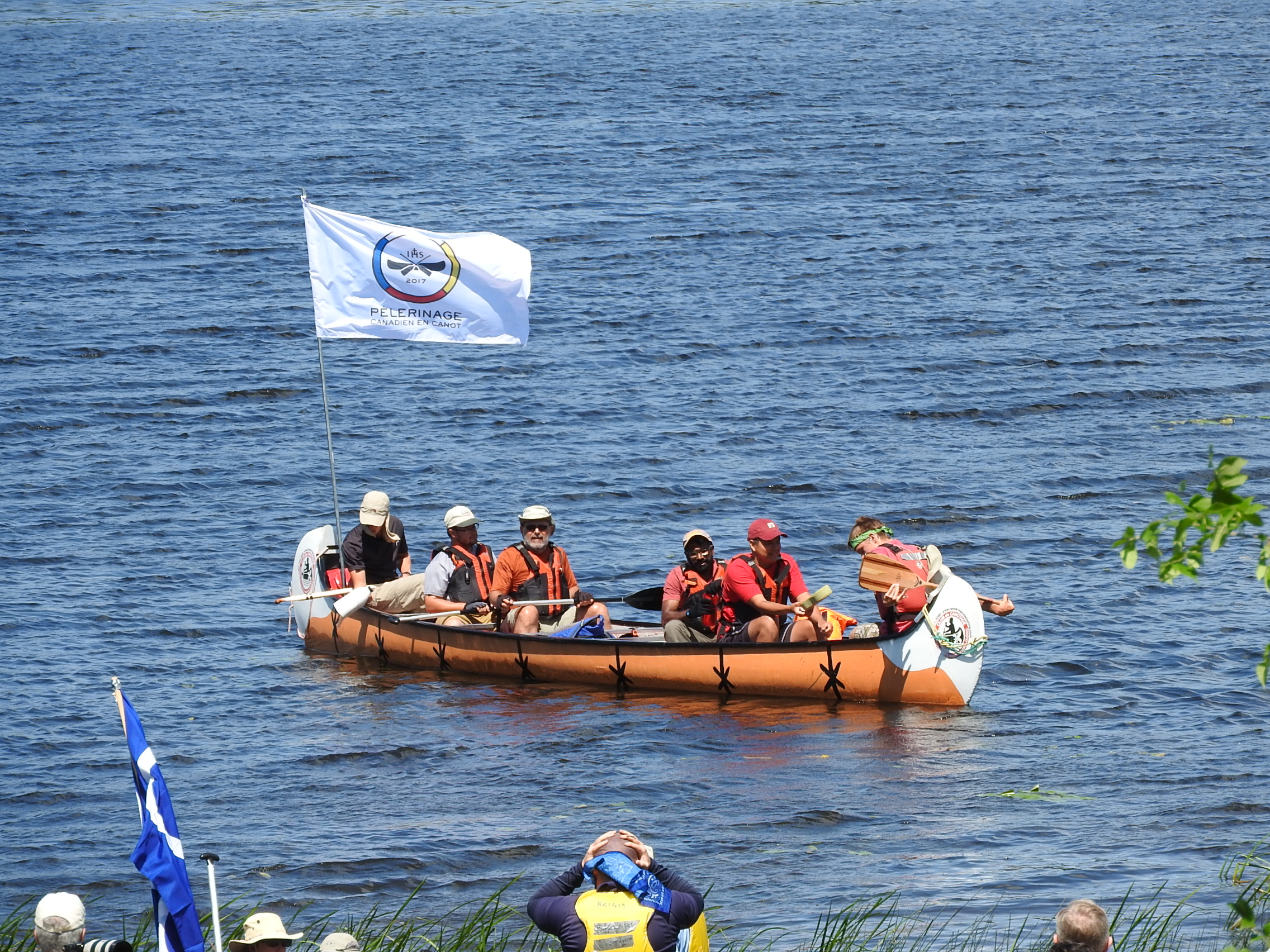


Father Hasina on the far right waving


Before we left to go home we walked through the beautiful Stations of the Cross that were built by John, Donna, and Jean's brother


The Canadian Canoe Pilgrimage (CCP) is a project inspired by Canada’s Truth and Reconciliation Commission (TRC) with the hope of encouraging intercultural and interreligious dialogue and learning. Participants, both Indigenous and non-Indigenous, will be immersed in each other’s customs and traditions. Through this immersion, the goal is to foster respect, trust, dialogue, and hopefully friendship — the building blocks for reconciliation. The canoe route is a traditional First Nations trading route that was travelled by early European settlers such as Samuel de Champlain and Jean de Brébeuf, who were welcomed and guided by the Indigenous Peoples of this land. This pilgrimage will begin at Sainte-Marie among the Hurons in Midland, on the shore of Georgian Bay, on July 21 and end on August 15 on the St. Lawrence River at the Kahnawake First Nation, close to Montreal. The community of paddlers making this 850-kilometre, 25-day voyage is comprised of Indigenous Peoples, Jesuits, English and French Canadians, men and women – all desiring to travel together on a path of healing and friendship. The route follows a similar one paddled by 24 young Jesuits in 1967. For more information, and to donate, please go to the Canoe Pilgrimage website. |
Does Affirming a Student’s Transgender Identity Constitute Mental-Health Counseling?| National Catholic Register
Does Affirming a Student’s Transgender Identity Constitute Mental-Health Counseling?| National Catholic Register: In a case that could have national implications, answering that question may help determine parents’ lawsuit in Massachusetts against public-school officials...
Subscribe to:
Comments (Atom)